Filter bindings in Jitterbit App Builder
Filter bindings enable the configuration of complex binding behaviors that extend beyond simple equality matches. In standard App Builder functionality, one panel can restrict the results of another via binding criteria. While traditional panel bindings are limited to exact matches, filter panels allow developers to perform sophisticated bindings using a variety of SQL operators.
How to set up filter bindings
To set up filter bindings, follow these steps:
-
Open the desired page and select Action Drawer > Design this page. Alternatively, open the desired page's edit screen.
-
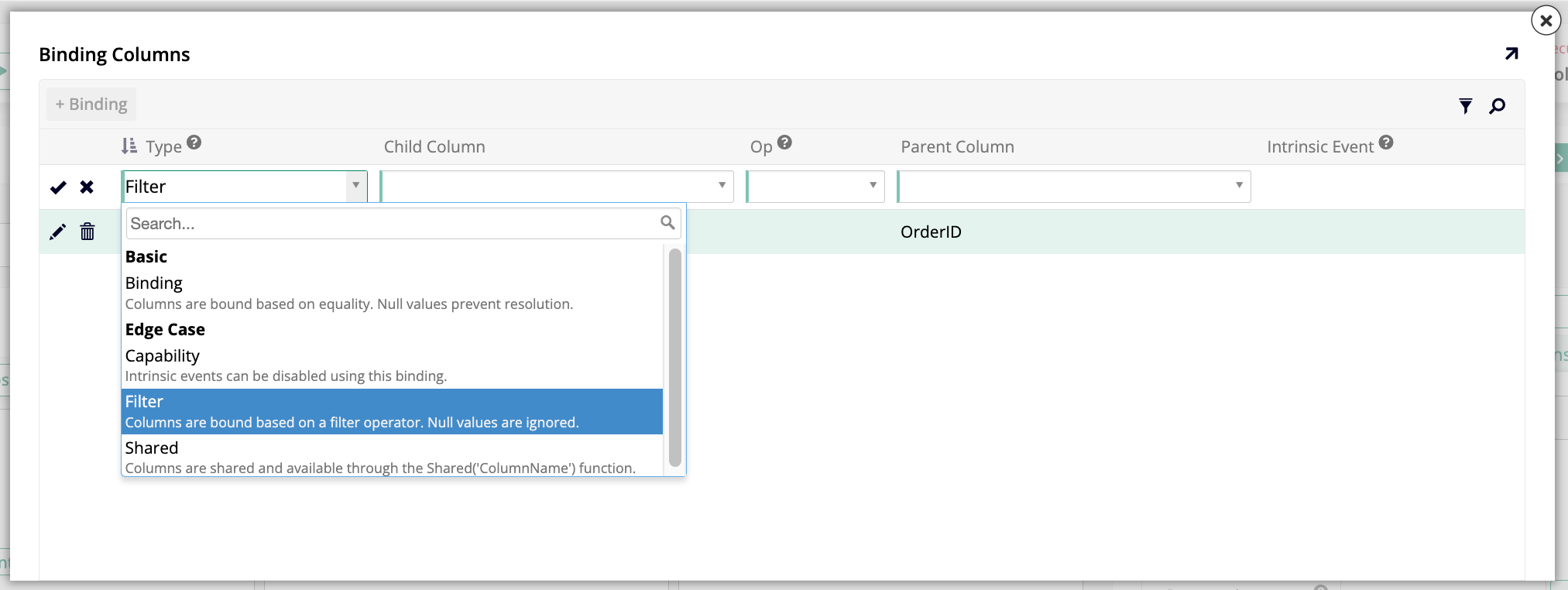
Click the binding column icon on the panel you are working on. The Binding Columns dialog opens:
-
Click + Binding to create a new binding and set the Type to Filter.
-
Select a Child Column.
-
In the Op field, which stands for Operator, the specific operator must be defined. The options include:
-
Equals / Not Equals
-
Less Than / Less Than Or Equals
-
Greater Than / Greater Than Or Equals
-
Like / Not Like
-
-
Select a Parent Column.
-
Click to save.
Implement session or user-based filters
A powerful application of filter bindings is the creation of session-based or user-specific data filters. This allows an application to display data tailored to the person currently logged into the system.
To implement this workflow, follow these general steps:
-
Create a Filter Source: Configure a Form panel that targets a managed table or utilizes a
WHEREclause to limit results to the single record associated with the current login. -
Define Filter Controls: Add controls to this Form panel that will serve as the criteria for filtering.
-
Establish the Filter Binding: Bind a second panel (such as a Grid, Chart, or Tile panel) to the first panel.
-
Configure Operators: In the binding settings, set the Type to Filter and select the appropriate operator to link the user's input to the data results.
Known limitations
The Filter binding feature currently has these limitations:
-
It does not support simple search.
-
It does not support logic for
IS [NOT] NULL,[NOT] IN, orOR. -
The filter operates on the result set rather than the data object itself.
-
It does not support pivot controls.
-
Neither Lists nor Page links currently support filter criteria.