Table wizard in Jitterbit App Builder
Feature overview
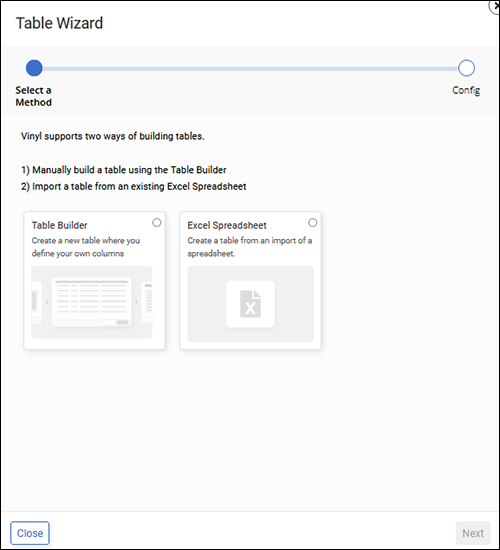
In App Builder, tables are created in the Data layer to store a collection of related data in a structured format. The Table wizard allows you to create a new table using one of two supported methods, Table Builder or Excel Spreadsheet:
-
Table Builder: Manually create a table and define columns.
-
Excel Spreadsheet: Import an Excel spreadsheet to create a table. Supported file types are
.csv,.txt,.xls,.xlsm, or.xlsx.Note
Only users with permission to create tables in the Data layer can use the Table wizard.
Name tables according to App Builder's naming methodology and guidelines. A table must have at least one defined primary key. The Table wizard also guides you through the steps to create a page based on the table's data.
Access the Table wizard
The Table wizard can be accessed from the Design Center. Follow these steps:
-
From any page in an App Builder app, open the Action drawer by clicking the icon in the top right corner.
-
Click Design Center.
-
Click the + Table button and the Table wizard opens.
Video tutorials
Use table builder to manually define a table
To create a table manually using the Table wizard, follow these steps:
-
After accessing the Table wizard, select the Table Builder option.
-
Click Next.
-
Enter a Table Name. This must be unique for the data source, for example:
Category. -
Click Next.
-
App Builder automatically adds the table's Primary Key column.
-
To add a Title column, click the Add Title button, and then click Proceed.
Note
In App Builder, a Title column translates a record's primary key UUID to a user-friendly named value, such as
Dairy. When defined, a Title column enables you to automatically build list objects. -
To add additional columns, click the Add Column button.
-
Provide a Name for the column. Example:
Description. -
Select the Logical data type for the column. Example:
NVarchar (50).
-
-
Click Next.
-
Review the changes App Builder will make and click Generate Pages to proceed to the Create Pages wizard:
-
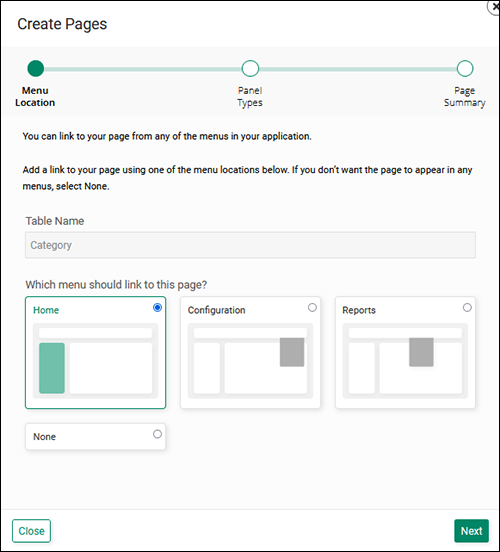
Select a menu to link the new page to. The following options are available:
-
Home: The new page will be linked from the Home page.
-
Configuration: The new page will be linked under the Configuration menu.
-
Reports: The new page will be linked under the Reports menu.
-
None: No navigation link will be generated for the new page.
-
-
Click Next.
-
Review the available Panel Types and select the desired option.
-
Click Next to proceed.
-
Review the changes App Builder will make and click Create Pages to advance.
Use Excel spreadsheet to import a table
To create a table by importing an existing Excel spreadsheet with help from the Table wizard, follow these steps:
-
After accessing the Table wizard, select the Excel Spreadsheet option.
-
Click Next.
-
Click the Browse link and locate the file to upload.
-
Select the file and click Open.
-
Confirm the upload is complete and click Next.
-
Review the data mapping settings App Builder will use to import the file and make any necessary changes:
-
Table Name: The name that will be assigned to the table.
-
File Type: Represents the file extension for the upload. Supported types are
.csv,.txt,.xls,.xlsm, or.xlsx. -
Delimiter Type: The delimiter for
.csvfiles. The typical delimiter is a comma. This field is ignored for Excel files. -
Contains Header: Select this option if the file contains a header row.
-
Header Row: The row number of the header row.
-
Starting Data Row: The row number where data begins.
-
Customize Columns: Choose either Auto (default) or Customize:
Note
By selecting Customize and clicking Next, you can verify that column names and data types are correct and preview the first few rows of the import. Click Previous to correct any issues with columns and data types. Otherwise, click Import.
-
-
Click Import.
-
Click Create Page to initiate the Create Pages wizard.
-
Select a menu to link the new page to. The following options are available:
-
Home: The new page will be linked from the Home page.
-
Configuration: The new page will be linked under the Configuration menu.
-
Reports: The new page will be linked under the Reports menu.
-
None: No navigation link will be generated for the new page.
-
-
Click Next.
-
Review the available Panel Types and select the desired option.
-
Click Next to proceed.
-
Review the changes App Builder will make and click Create Pages to advance.
Next steps
After creating your tables, you should define relationships between them to enforce data integrity and enable automatic UI enhancements.