Capability bindings in Jitterbit App Builder
Capability bindings represent a specialized binding type that links the functional state of a child panel to the data or events of a parent panel or page data object. This feature allows developers to dynamically control the visibility or editability of UI controls based on specific conditions.
A primary advantage of capability bindings is their ability to affect the Create button on child panels. While the standard "column usage block" feature can restrict interactions within existing rows, it cannot impact the Create button because that button exists independently of any specific row in the panel. Capability bindings bridge this gap by tying the button's state to the parent's context.
Supported panel types
Capability bindings can be applied to a variety of panel types within the UI layer:
-
Single-row and multi-row panels.
-
Dynamic results panels.
-
Calendar, board, and lane panels (Note: These support the Insert event only).
How to configure a capability binding
The configuration process for a capability binding is similar to setting up standard binding columns, but requires selecting "Capability" as the binding type.
For example, you may want to hide the Create button on an "Orders" child panel if the "Customer" on the parent panel is marked as "Inactive". This assumes your parent business object includes a status field (e.g., a column named "Active") that returns the appropriate capability status code.
-
Open the desired page and select Action Drawer > Live Designer. Alternatively, open the desired page's edit screen by going to App Workbench > Pages.
-
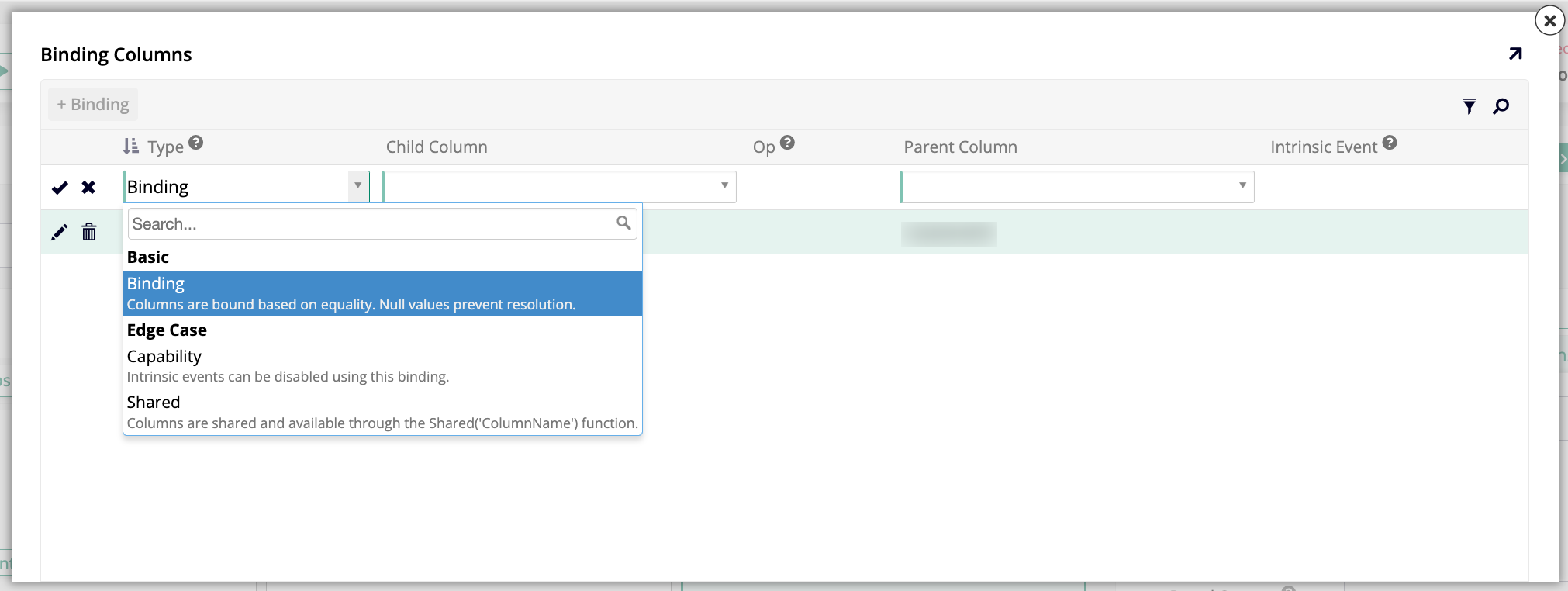
Click the binding column icon on the child panel you wish to restrict. The Binding Columns dialog opens:
-
Click + Binding to create a new binding and set the Type to Capability.
-
The Parent field identifies the column in the parent panel or page data object that contains the status value used to drive the binding. Set it to the column containing your status flag (for instance, "Active").
-
The Intrinsic Event field maps the binding to a specific action, such as Insert, Update, or Delete. Set it to the action you are targeting, such as Insert, to control the Create button.
-
Save your changes and refresh the application to test the dynamic UI behavior.
The behavior of the UI is determined by capability statuses, which follow the same logic as conditional formatting:
-
0: Default behavior. -
1: Hidden (the control or button is not visible). -
2: Disabled (the control or button is visible but cannot be interacted with).
Note
If a capability binding is configured to disable the Edit event, the system will automatically hide the edit icon on any associated multi-row panel rows.